The Broad Dollar index is a much wider or "broader" representation of the plight of the US Dollar on the global markets as the basket from which the index is created is more representative of the globe than the smaller basket of currencies that comprise the USDX.
Even at that, it still shows a very similiar pattern to the USDX and is also now technically within striking distance of its 2008 low having broken downside support near 97.
It is highly unlikely that gold will not make a new lifetime high if this support level near 95 fails. I can easily see it above $1500 were this to occur.
I also believe that the US Dollar is at levels that are now necessitating it to be watched very closely by the US monetary authorities. In much the same manner as the Yen went flying to the upside, so too the Dollar could go crashing to the downside if the speculators decide to sit on it in earnest. While the Fed and the US officials WANT a lower Dollar, they do not want a Dollar crash. Sometimes it is easier to talk about such things than to actually accomplish it.
Should the Dollar carry trade increase in intensity, every hedge fund on the planet would be arrayed against the G7. That would be weird to say the least as the G7 monetary officials do not want the Yen any higher yet if they are not careful they may end up pushing the Dollar past the point of no return. What an awful stinking mess!
"When misguided public opinion honors what is despicable and despises what is honorable, punishes virtue and rewards vice, encourages what is harmful and discourages what is useful, applauds falsehood and smothers truth under indifference or insult, a nation turns its back on progress and can be restored only by the terrible lessons of catastrophe." … Frederic Bastiat
Evil talks about tolerance only when it’s weak. When it gains the upper hand, its vanity always requires the destruction of the good and the innocent, because the example of good and innocent lives is an ongoing witness against it. So it always has been. So it always will be. And America has no special immunity to becoming an enemy of its own founding beliefs about human freedom, human dignity, the limited power of the state, and the sovereignty of God. – Archbishop Chaput
Trader Dan's Work is NOW AVAILABLE AT WWW.TRADERDAN.NET
Monday, March 21, 2011
US Dollar update
As has been the pattern over the last view trading sessions, the US Dollar has become the whipping boy for the global forex trading crowd.
Today is was strength in the Euro which sent it lower. Talk is picking up that the next move in regards to interest rates by the ECB will be to raise them. That contrasts sharply with the situation around the US Dollar where rates will remain low for the immediate future.
Given this fact, it is difficult to make a case for the Dollar right now as it moves ever closer to a long term inflection point on the charts. It is sitting only a mere 40-45 points from this support level with the RSI not yet in oversold territory. That alone is rather foreboding.
Each blip higher in the Dollar has kept the RSI in a defined downtrend as indicated by the inability to break the downtrend line shown on that indicator.
Simply put, there is currently no strength in the Dollar. Keep in mind this is taking place against a backdrop where the Yen is being kept weak. Imagine where the Dollar would be had not the G7 intervention taken place?
I also happen to believe that is one of the reasons that made it easy for the G7 to agree to a round of coordinated intervention. It might have also been to help the Dollar also! Had the Yen not been taken down, the Dollar would have crashed through a major support level.
Today is was strength in the Euro which sent it lower. Talk is picking up that the next move in regards to interest rates by the ECB will be to raise them. That contrasts sharply with the situation around the US Dollar where rates will remain low for the immediate future.
Given this fact, it is difficult to make a case for the Dollar right now as it moves ever closer to a long term inflection point on the charts. It is sitting only a mere 40-45 points from this support level with the RSI not yet in oversold territory. That alone is rather foreboding.
Each blip higher in the Dollar has kept the RSI in a defined downtrend as indicated by the inability to break the downtrend line shown on that indicator.
Simply put, there is currently no strength in the Dollar. Keep in mind this is taking place against a backdrop where the Yen is being kept weak. Imagine where the Dollar would be had not the G7 intervention taken place?
I also happen to believe that is one of the reasons that made it easy for the G7 to agree to a round of coordinated intervention. It might have also been to help the Dollar also! Had the Yen not been taken down, the Dollar would have crashed through a major support level.
Still watching Silver Deliveries
There were only 2 deliveries posted against the March Silver contract today bringing the total deliveries for the month to 980. I should note however this is the first day since the delivery process began that the March Silver contract did not see a reduction in open interest. Interestingly enough, it witnessed an increase of 5 contracts on Friday of last week. Apparently some guys are planning on taking some silver and decided that the market was going to move higher with the return of the risk trades. A total of 898 contracts remain open in the March.
The spread between the March, May and July contracts for all practical purposes is zero with the March and May trading even. I would watch out if March goes to a premium to the May contract as that would portend that there are issues related to the delivery process which are bullish for the market. Such a development would indicate that the longs are getting ready to squeeze the shorts.
This is getting interesting as the battle to contain the metal below $36 is heating up. The shorts had better hope that they can push the market away from $36 convincingly or they are in trouble.
The spread between the March, May and July contracts for all practical purposes is zero with the March and May trading even. I would watch out if March goes to a premium to the May contract as that would portend that there are issues related to the delivery process which are bullish for the market. Such a development would indicate that the longs are getting ready to squeeze the shorts.
This is getting interesting as the battle to contain the metal below $36 is heating up. The shorts had better hope that they can push the market away from $36 convincingly or they are in trouble.
HUI morning update 11:00 AM CDT
The mining shares are moving higher alongside both the broader equity markets this morning and the precious metals. The shares are reacting to what the market perceives as an improvement in the situation regarding the nuclear reactors in Japan.
If enough of the shares can maintain their early gains and do not fade, there is a chance that the HUI could push back into the resistance zone noted on the chart. Clearing this zone would set the index on a path towards 560, which is about midway between the recent peak near 580 and the drop down to 520. That is where the next battle would then be joined.
Failure to clear the resistance zone will see a setback towards 540 initially with additional support below that near 535 followed by 530.
If enough of the shares can maintain their early gains and do not fade, there is a chance that the HUI could push back into the resistance zone noted on the chart. Clearing this zone would set the index on a path towards 560, which is about midway between the recent peak near 580 and the drop down to 520. That is where the next battle would then be joined.
Failure to clear the resistance zone will see a setback towards 540 initially with additional support below that near 535 followed by 530.
4 Hour Gold Chart
Gold immediately gapped higher on its reopening for trade Sunday evening in Asia (Monday morning there). I am impressed by the fact that the gap was over and through the strong resistance level that had been blocking the market from moving higher last Friday. That level was near $1422 - $1424. Thus far it has not even gone back down to retest the gap breakout. While it is still early in the session, this is significant because it reveals that the buying is of a nature that it is not abating.
Resistance has formed at $1435 however. If gold can punch
through this level as the day wears on, it looks to me like it is going to make a run to the all time high just above $1440.
Volume is decent but I would like to see it a bit stronger to be honest. It suggest a bit of hesitancy to take it through $1435 at this stage.
Support now moves to the level just below the gap from last evening. That comes in near $1420 on the downside. Bulls will not want to see it fail there should it attempt a setback and retest of the gap.
Technical indicators are positive at this time. They are also reflecting the resistance at $1435 however.
Resistance has formed at $1435 however. If gold can punch
through this level as the day wears on, it looks to me like it is going to make a run to the all time high just above $1440.
Volume is decent but I would like to see it a bit stronger to be honest. It suggest a bit of hesitancy to take it through $1435 at this stage.
Support now moves to the level just below the gap from last evening. That comes in near $1420 on the downside. Bulls will not want to see it fail there should it attempt a setback and retest of the gap.
Technical indicators are positive at this time. They are also reflecting the resistance at $1435 however.
Saturday, March 19, 2011
Trader Dan on King World News Weekly Metals Wrap
Click here to listen to my regular weekly radio interview with Eric King for the KWN Weekly Metals Wrap.
http://www.kingworldnews.com/kingworldnews/Broadcast/Entries/2011/3/19_KWN_Weekly_Metals_Wrap.html
When Theory and Real Life Collide - thoughts on the Yen
In response to some private emails as well as a couple of comments from my recent articles on the Yen intervention, I thought it worthwhile to deal with what I believe is a clash between theory and the real world.
What I am referring to are articles written by two men, both of whom I greatly respect, who argue that the Yen should be permitted to rally instead of being undercut by a coordinated G7 intervention effort. The claim is that a strengthening Yen would be beneficial to the Japanese since they are going to require massive amounts of raw materials with which to rebuild their battered nation. This strength would outweigh any competitive advantage gained through a weakening of the Yen which would aid the heavily export-dependent Japanese economy or so they claim.
Let me first of all state that I believe that a nation's long term economic strength can only be maintained if it possesses a strong currency. The idea of deliberately short-circuiting one's own currency in an attempt to ramp up exports is harmful in the longer term as it tends to increase the price of all imported goods coming into that nation and as such is normally inflationary, all things being equal. That eventually works to undercut the quality of life in that nation and weakens it in the long run.
That being said, the real world functions not on theory but on practice. We do not yet live in a perfect world, where every nation lets its currency move to a natural rate of equilibrium. Instead of we have nations such as China which work to keep their currency artificially lower than would be the case where it left to float freely. We have the US engaging in Quantitative Easing so that it can weaken its own currency and thus perform an ipso facto default on the massive amount of debt it now owes. We have Brazil intervening in the currency markets regularly attemping to undercut the strength in the Real to aid them in retaining their share of the export markets. We have South Korea doing the same in regards to their Won, and thus the list goes on and on.
In such a fictitious world, one could make the argument that the Japanese Yen should be allowed to strengthen to aid Japan in its rebuilding efforts by making the cost of raw materials much cheaper. The reality however is that Japan must deal with the world as it now is, and not as we would like to see it. This is the reason that I must dismiss the idea that the Japanese should stand idly by and allow a massive unwinding of a leveraged carry trade take their currency to levels that would crush their export markets and render them unable to compete.
Let's begin therefore by admitting that I am complete agreement with those who claim that the Yen should be allowed to strengthen on this one condition - That the events of the last week had occured back in 2007 or 2008 when the Yen was at a significantly LOWER level on the crosses than it was this past week.
Please examine the long term chart of the Yen that I posted earlier here on my site (I am once again posting it here for your convenience). If you are to come away with only one point in this discussion, let it be this: THE JAPANESE YEN IS AT THE HIGHEST LEVEL AGAINST THE US DOLLAR IN MORE THAN 35 YEARS. It might be an even longer period; I simply do not have the chart data going back beyond the early 1970's.
My answer to those who insist that the Yen should be allowed to further strengthen, no matter what that will do to Japan's export-related industries, is that their argument has ALREADY taken effect. The YEN is not a weak currency under any method of looking at it when it is compared to the US Dollar. How could it be stated that the Japanese monetary authorities should let it rise even further and turn a blind eye to the actions of a runamok speculative short squeeze?
If you note the chart carefully, you can see that since the Yen carry trade began being unwound in mid 2008, the Yen has increased in value against the Dollar by nearly 40%! That is an astonishing rate of increase.
Now consider the following - The Dollar is still the world's reserve currency and as such most commodities are generally priced on the global market in terms of US Dollars. In effect that means if commodity prices had remained flat and gone nowhere in price since the fall of 2008, the Japanese would be able to purchase 40% more cotton, corn, copper, wheat, etc today for the same amount of Yen than they had been able to buy back in 2008. Here is exactly what those who are advocating for a stronger Yen are arguing. The problem however for Japan is that the same goods that the Japanese are attempting to sell to the US consumer market have now increased 40% if prices were to have remained at the same level that they were back in 2008. That puts the Japanese at a serious competitive disadvantage when dealing with other nations looking to sell their products to the US.
Consider also that while China has loosened its currency band to the point where the yuan has been able to strengthen some against the Dollar, it still maintains a sort of quasi-peg to the Dollar meaning that this gives Chinese manufacturers a decided advantage against Japanese exporters for US market share.
I realize that there are other nations and blocks out there such as the EU and the rising Latin American economies, but for the sake of simplicity I am only dealing with the China/Japan/US relation. Given this current level of the Yen therefore, and the loss of Japanese export competitiveness with China, I do not understand how some can assert that the Yen should be allowed to strengthen even further from current levels, especially given the fact that the Yen strength is not due to normal reasons but is instead the product of a speculative unwind of leveraged trades and in that case is abnormal.
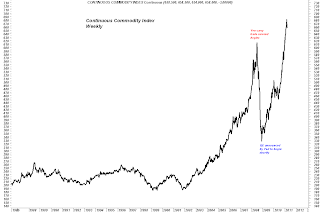
Now let's take a look at a chart that many of you are now familiar with as I have been referring to it quite often over the last few years, namely the Continuous Commodity Index or CCI. Note the massive selloff in the CCI after it peaked in mid 2008 as the credit crisis erupted and the carry trade was unwound. That move towards risk aversion resulted in wholesale selling of commodities across the board.
As you can see the plunge in commodity prices did not stop until the Federal Reserve announced that it would soon commence a program known as Quantitative Easing. That had the immediate effect of launching a multi-year rally in commodity prices which took the index past the all time peak it had previously reached in the summer of 2008. As of the close of trading this Friday, March 18, the CCI is currently 7.8% higher than its peak of 2008. It is apparent that the Fed's efforts at staving off deflationary pressures has indeed been successful if you call a soaring of food prices and metal and energy prices "successful".
Now let's take a look at this same exact index although this time around let's view it through the prism of the Japanese Yen. In other words, we are going to adjust the chart to see the performance of the commodity sector when priced in terms of the Japanese Yen. Keep in mind that this speaks directly to the point of the fact that world commodity prices are quoted in terms of the US Dollar because it is the global reserve currency.
As you can see this chart looks vastly dissimiliar to the CCI chart above. While Dollar priced commodities are trading 7.8% higher than their peak level in 2008, Yen priced commodities are currently trading at a DISCOUNT of 18% to that same peak. In other words, because of the strength in the Yen, the Japanese economy has been somewhat inoculated from the soaring cost of commodities worldwide. They are actually buying commodities at a discount to what they were paying for them in 2008 even though the entire sector has been soaring into new highs ever since the Fed began its QE policies.
I point this out to say that the Yen is already trading at levels which are high enough to allow it purchase all the commodities it needs without having to suffer an inflationary impact on its own population. Furthering strengthening of the Yen would of course bring prices for commodities down even further if nothing else changed but any gains from that would be more than offset by a further weakening of the competitiveness of the Japanse exporters.
I would argue that the Japanese authorities could actually allow the Yen to weaken from its current levels without affecting them excessively when it comes to purchasing the raw materials and foods required for the rebuilding process. Many nations across the Pacific Rim are grappling with huge inflationary problems; Japan is not and that is mainly because its yen is already so overvalued.
What Japan is going to require more than anything right now is growth in its economy. If that segment of their economy which is so vital, namely their export related segment, is to remain competitive on the global markets, the Yen is too richly valued in my view to permit this. It will need to weaken to give their manufacturers a fighting chance agains the Dragon China and some of the other powerhouses of the region. There is plenty of room for the Yen to weaken and come down in value without feeding into the inflationary type spiral that one normally sees in a country whose currency is moving lower. If those who are advocating for a rising Yen had made this argument back in 2007 or even in early 2008, I would be squarely on their side. The fact that the Yen has risen 40% and higher since then makes their argument unconvincing especially in light of the current facts.
One last thing, a move by China to let the Yuan seeks its own level, free of any attempts to check its rise, would also work to help Japanese competitiveness not only with direct trade between those two nations but between Japan and the US. Such an event might make this entire discussion whether or not it was appropriate to intervene on the behalf of the surging Yen moot.
What I am referring to are articles written by two men, both of whom I greatly respect, who argue that the Yen should be permitted to rally instead of being undercut by a coordinated G7 intervention effort. The claim is that a strengthening Yen would be beneficial to the Japanese since they are going to require massive amounts of raw materials with which to rebuild their battered nation. This strength would outweigh any competitive advantage gained through a weakening of the Yen which would aid the heavily export-dependent Japanese economy or so they claim.
Let me first of all state that I believe that a nation's long term economic strength can only be maintained if it possesses a strong currency. The idea of deliberately short-circuiting one's own currency in an attempt to ramp up exports is harmful in the longer term as it tends to increase the price of all imported goods coming into that nation and as such is normally inflationary, all things being equal. That eventually works to undercut the quality of life in that nation and weakens it in the long run.
That being said, the real world functions not on theory but on practice. We do not yet live in a perfect world, where every nation lets its currency move to a natural rate of equilibrium. Instead of we have nations such as China which work to keep their currency artificially lower than would be the case where it left to float freely. We have the US engaging in Quantitative Easing so that it can weaken its own currency and thus perform an ipso facto default on the massive amount of debt it now owes. We have Brazil intervening in the currency markets regularly attemping to undercut the strength in the Real to aid them in retaining their share of the export markets. We have South Korea doing the same in regards to their Won, and thus the list goes on and on.
In such a fictitious world, one could make the argument that the Japanese Yen should be allowed to strengthen to aid Japan in its rebuilding efforts by making the cost of raw materials much cheaper. The reality however is that Japan must deal with the world as it now is, and not as we would like to see it. This is the reason that I must dismiss the idea that the Japanese should stand idly by and allow a massive unwinding of a leveraged carry trade take their currency to levels that would crush their export markets and render them unable to compete.
Let's begin therefore by admitting that I am complete agreement with those who claim that the Yen should be allowed to strengthen on this one condition - That the events of the last week had occured back in 2007 or 2008 when the Yen was at a significantly LOWER level on the crosses than it was this past week.
Please examine the long term chart of the Yen that I posted earlier here on my site (I am once again posting it here for your convenience). If you are to come away with only one point in this discussion, let it be this: THE JAPANESE YEN IS AT THE HIGHEST LEVEL AGAINST THE US DOLLAR IN MORE THAN 35 YEARS. It might be an even longer period; I simply do not have the chart data going back beyond the early 1970's.
My answer to those who insist that the Yen should be allowed to further strengthen, no matter what that will do to Japan's export-related industries, is that their argument has ALREADY taken effect. The YEN is not a weak currency under any method of looking at it when it is compared to the US Dollar. How could it be stated that the Japanese monetary authorities should let it rise even further and turn a blind eye to the actions of a runamok speculative short squeeze?
If you note the chart carefully, you can see that since the Yen carry trade began being unwound in mid 2008, the Yen has increased in value against the Dollar by nearly 40%! That is an astonishing rate of increase.
Now consider the following - The Dollar is still the world's reserve currency and as such most commodities are generally priced on the global market in terms of US Dollars. In effect that means if commodity prices had remained flat and gone nowhere in price since the fall of 2008, the Japanese would be able to purchase 40% more cotton, corn, copper, wheat, etc today for the same amount of Yen than they had been able to buy back in 2008. Here is exactly what those who are advocating for a stronger Yen are arguing. The problem however for Japan is that the same goods that the Japanese are attempting to sell to the US consumer market have now increased 40% if prices were to have remained at the same level that they were back in 2008. That puts the Japanese at a serious competitive disadvantage when dealing with other nations looking to sell their products to the US.
Consider also that while China has loosened its currency band to the point where the yuan has been able to strengthen some against the Dollar, it still maintains a sort of quasi-peg to the Dollar meaning that this gives Chinese manufacturers a decided advantage against Japanese exporters for US market share.
I realize that there are other nations and blocks out there such as the EU and the rising Latin American economies, but for the sake of simplicity I am only dealing with the China/Japan/US relation. Given this current level of the Yen therefore, and the loss of Japanese export competitiveness with China, I do not understand how some can assert that the Yen should be allowed to strengthen even further from current levels, especially given the fact that the Yen strength is not due to normal reasons but is instead the product of a speculative unwind of leveraged trades and in that case is abnormal.
Now let's take a look at a chart that many of you are now familiar with as I have been referring to it quite often over the last few years, namely the Continuous Commodity Index or CCI. Note the massive selloff in the CCI after it peaked in mid 2008 as the credit crisis erupted and the carry trade was unwound. That move towards risk aversion resulted in wholesale selling of commodities across the board.
As you can see the plunge in commodity prices did not stop until the Federal Reserve announced that it would soon commence a program known as Quantitative Easing. That had the immediate effect of launching a multi-year rally in commodity prices which took the index past the all time peak it had previously reached in the summer of 2008. As of the close of trading this Friday, March 18, the CCI is currently 7.8% higher than its peak of 2008. It is apparent that the Fed's efforts at staving off deflationary pressures has indeed been successful if you call a soaring of food prices and metal and energy prices "successful".
Now let's take a look at this same exact index although this time around let's view it through the prism of the Japanese Yen. In other words, we are going to adjust the chart to see the performance of the commodity sector when priced in terms of the Japanese Yen. Keep in mind that this speaks directly to the point of the fact that world commodity prices are quoted in terms of the US Dollar because it is the global reserve currency.
As you can see this chart looks vastly dissimiliar to the CCI chart above. While Dollar priced commodities are trading 7.8% higher than their peak level in 2008, Yen priced commodities are currently trading at a DISCOUNT of 18% to that same peak. In other words, because of the strength in the Yen, the Japanese economy has been somewhat inoculated from the soaring cost of commodities worldwide. They are actually buying commodities at a discount to what they were paying for them in 2008 even though the entire sector has been soaring into new highs ever since the Fed began its QE policies.
I point this out to say that the Yen is already trading at levels which are high enough to allow it purchase all the commodities it needs without having to suffer an inflationary impact on its own population. Furthering strengthening of the Yen would of course bring prices for commodities down even further if nothing else changed but any gains from that would be more than offset by a further weakening of the competitiveness of the Japanse exporters.
I would argue that the Japanese authorities could actually allow the Yen to weaken from its current levels without affecting them excessively when it comes to purchasing the raw materials and foods required for the rebuilding process. Many nations across the Pacific Rim are grappling with huge inflationary problems; Japan is not and that is mainly because its yen is already so overvalued.
What Japan is going to require more than anything right now is growth in its economy. If that segment of their economy which is so vital, namely their export related segment, is to remain competitive on the global markets, the Yen is too richly valued in my view to permit this. It will need to weaken to give their manufacturers a fighting chance agains the Dragon China and some of the other powerhouses of the region. There is plenty of room for the Yen to weaken and come down in value without feeding into the inflationary type spiral that one normally sees in a country whose currency is moving lower. If those who are advocating for a rising Yen had made this argument back in 2007 or even in early 2008, I would be squarely on their side. The fact that the Yen has risen 40% and higher since then makes their argument unconvincing especially in light of the current facts.
One last thing, a move by China to let the Yuan seeks its own level, free of any attempts to check its rise, would also work to help Japanese competitiveness not only with direct trade between those two nations but between Japan and the US. Such an event might make this entire discussion whether or not it was appropriate to intervene on the behalf of the surging Yen moot.
Subscribe to:
Posts (Atom)


