One of the reasons that leveraged carry trade positions explode is a rally in the underlying currency which has financed the trade. In this case, it is the Japanese Yen which has been the funding currency. Those who put on this sort of trade are effectively short the Yen because when they exit the trade, they have to close out the positions that they financed and then buy Yen to pay back the original loan in Yen terms. As the funding currency rallies, they begin losing money because they are forced to pay a higher price for the Yen when they do the foreign currency exchange.
When we saw the Yen begin rallying sharply this past week it set off a cascade of unwinding of the carry trade as hedge funds dumped both stocks and commodities that had been purchased and then leveraged up as risk trades were quickly going underwater.
It now appears that the Bank of Japan has secured the cooperation of the entire G7 in knocking down the Yen which most agree had soared to levels that were nowhere near commensurate with an accurate valuation of the currency given the fiscal condition of the nation.
If it now appears that the G7 agrees to keep the Yen at bay then it could well be that the same hedge funds that were blowing out of their carry trades will be eager to reinstate them since they will feel that they have an effective upside cap on the Yen thus eliminating an element of risk in the trade.
If the nuclear plant situation in Japan can indeed get stabilized, that, combined with the cap on the Yen, could be the signal for the hedgies to pile back into the carry trade. It would not surprise me to learn that the BOJ would actually welcome such an event because it would keep a lid on the Yen and would thus serve their purposes of preventing the Yen from strengthening.
I would therefore view this as setting in place the factors necessary for keeping gold and silver well supported in price again. We will see how the market is interpreting these events in the trading that takes place over the next few trading sessions.
Thursday, March 17, 2011

Bank of Japan Ventures forth to punish the Speculators
The Chart picture says it all. This time however it is not a unilateral move by the BOJ. It is a coordinated G7 takedown of the Yen. About time!


Even the Government's Phony CPI can no longer hide Rising Prices
The Labor Department released its CPI numbers for the month of February this morning. Guess what? Even the statistical gymnastics employed by these masters of illusion could not conceal what has been happening to food prices since the middle of last year. Ask any average US housewife and you would have already known this long before the CPI revealed it but the doubling of grain prices, the surge in wholesale beef and pork costs, rising prices for cotton, etc, were bound to show up sooner or later at the retail level.
As said many times here, a business can only absorb rising wholesale costs for so long. If it wants to remain in business, it must eventually pass these increases on to consumers, especially if it intends to actually increase its hiring.
While some food costs are coming down on the futures markets due to events in Japan and the exodus of a significant amount of speculative demand, it is reasonably sure that as long as the QE comes from the Fed and now more than likely from Japan, inflation in food and energy prices is not going to go away anytime soon.
Consider also the fact that the US Dollar continues to fall on the foreign exchange markets. This is going to have the effect of making imported goods more expensive for American consumers.
Higher gas and food costs push up consumer prices up 0.5 pct., most in nearly 2 years
As said many times here, a business can only absorb rising wholesale costs for so long. If it wants to remain in business, it must eventually pass these increases on to consumers, especially if it intends to actually increase its hiring.
While some food costs are coming down on the futures markets due to events in Japan and the exodus of a significant amount of speculative demand, it is reasonably sure that as long as the QE comes from the Fed and now more than likely from Japan, inflation in food and energy prices is not going to go away anytime soon.
Consider also the fact that the US Dollar continues to fall on the foreign exchange markets. This is going to have the effect of making imported goods more expensive for American consumers.
Consumer prices rise 0.5 pct., most since June '09
Higher gas and food costs push up consumer prices up 0.5 pct., most in nearly 2 years
On Thursday March 17, 2011, 11:04 am EDT WASHINGTON (AP) -- Americans paid more for food and gas in February, driving up consumer prices at the fastest pace in nearly two years.
The Consumer Price Index rose 0.5 percent in February, the largest increase since June 2009, the Labor Department said Thursday. Core prices, which exclude food and energy, rose only 0.2 percent, matching January's gain.
http://finance.yahoo.com/news/Consumer-prices-rise-05-pct-apf-904020158.html?x=0&sec=topStories&pos=3&asset=&ccode=
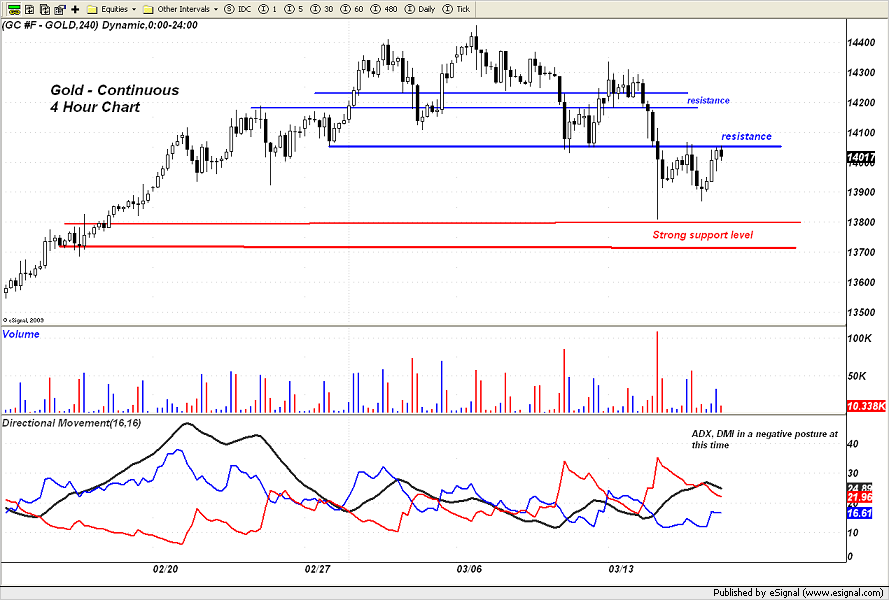
Gold finding resistance near $1402
Gold is stronger today but is having difficulty moving above $1402 and holding that level. For now it is attracting selling here even with the weakness in the US Dollar.

The Dollar is Flirting Dangerously with a Major Support Level
Risk trades are being put back on in today's session with a fury - markets which had been limit down this week and now limit up today. Corn and Cotton are two in particular which stand out. That's the thing about the hedge funds - they are either selling everything in sight or buying everything in sight. Hogs are pushing towards limit up also after being smashed limit down earlier this week. In short, the risk trades are being put back on with the same fury as they were being abandoned earlier this week.
Interestingly enough, the Dollar is getting slammed lower as all of the majors, with the exception of the Australian Dollar are trading higher, in some cases, sharply higher, against it. This fits with the pattern that I have detailed previously about the very weak response of the US Dollar to the safe haven play or the move towards risk aversion. It simply did not have the kind of upside strength that one would have expected during a time of crisis. That lack of strong move higher underscored what I believe is the inherent weakness in the greenback. Simply put, the Dollar looks sick.
The Yen makes up nearly 14% of the basket of currencies that comprise the USDX and its massive rally explains some of the weakness in the Dollar but the fact is the Dollar has not performed in the manner which many of us are accustomed during times of uncertainty or fear among global investors.
If the Yen is knocked down sharply by the BOJ, that will provide some strength to the Dollar index but that had better happen fairly soon or the Dollar is not going to hold this major support level near 76 that it is perched precariously above. All eyes still continue to wait for the BOJ.

Wednesday, March 16, 2011

This is not 2008
I wish to add some additional comments to the previous posts concerning the Japanese Yen, the carry trade and the potential for a QE program commencing by the Bank of Japan as a response to the events in that nation.
There is no doubt that a yen carry trade unwind has been occuring. See my earlier post about this where I discuss the price action of the Yen in comparison to the equity markets in general and the commodity markets.
I noted at the end of that article the following:
"The difference between what happened to commodities and other assets in 2008 was that the Fed was not engaging in any form of QE at the inception of the crisis. It could well be that we now have QE3 set in stone."
A subsequent post then explained my rationale for the Bank of Japan to engage in its own version of Quantitative Easing.
Let me go a bit further here and make a quick case for why this is not 2008 and why we do not need to fear the kind of meltdown in the commodity markets or the equity markets for that matter as occured back then.
First, once the Japanese are able get those nuclear reactors under control, one way or the other, this situation will have been priced in and the markets will reverse higher because that is the nature of markets - they price in the worst case scenario and then once that occurs, it is already discounted and the market then generally moves higher as all the bad news is already accounted for by the then current price level.
In 2008, no one knew the extent to which the tentacles of the derivatives that blew up reached. It was one shoe falling after another. An institution would fail, hope increased that the worst was over and then BLAM, down went another institution. It did not take long for investors to realize that the problem was not going to be dealt with quickly. Indeed, they soon began to understand how intertwined, how pervasive, and complex the problems were. In short, the market feared a near complete collapse of the entire financial system!
Here the situation is known ( an earthquake and the damage associated with it and the subsequent tsunami) and the market is factoring in the worst case scenario of a nuclear meltdown and the effects associated with that. That has forced an avalanche of selling by the hedge funds who are once again proving to be a plague on our financial system by their abuse of leverage. As they unwind that leverage, they sell assets purchased by the use of borrowed money, in this case the yen, (among other currencies including the Dollar to some extent), and then are forced to buy back the yen. If they had learned anything, they might have actually hedged some of these leveraged carry trades by taking some long side protection in the Yen itself but that is another story for another time.
Unlike 2008 therefore, this is not a SYSTEMIC EVENT. It is all connected to the events in Japan and even though it is forcing a yen carry unwind, it may have already run its course because the event, even though it is serious, is a temporary one, which will be resolved. Traders are not peering into some blind unknown as they were back in 2008 because quite frankly, the world had never before in its history seen anything like the "meltdown" associated with these financial weapons of mass destruction. No one knew what to expect and no one knew how it would all end.
Contrast to the events in Japan could not be more evident - while there is a serious knowledge deficit regarding what is actually occuring inside the nation of Japan particularly as it concerns the status of the nuclear reactors, there is a point at which this story will eventually come to a conclusion. In that sense, there is no unknown. The events will play out to their tragic ending leaving thousands of our Japanese brothers and sisters dead, their lives upended and a significant part of their nation in shambles. What will happen however is known - the nation will rebuild and the citizens will pick up the pieces of their lives and go on.
Second - back in 2008 there was no Fed QE and there was no Japan QE. Once the QE was announced by the Fed near the end of 2008, the hemorrhaging stopped and when the program actually commenced in March the next year, gold and the rest of the commodity world took off to the upside. The action by the Fed seemed to take the unknown out of the situation in the one sense that many believed that the Fed would not allow the financial system to utterly fail and when many had believed it would.
My strong belief is that the panic selling we are seeing in the markets is tied not to the earthquake damage or even the tsunami damage but AT THIS POINT to the unknown associated with a nuclear issue. That has jarred confidence and stirred fear and people are selling first and asking questions later.
The truth is the Japanese are going to require massive amounts of raw materials to rebuild their battered infrastructure and that is going to put a firm bid under the base metals and other commodity markets a bit further down the road. The implications are more of a short term bearish thing, long term bullish for commodities in general but particularly bullish for gold because of the implications associated with a QE program by another massive economy. My guess is that as soon as the nuclear issues get resolved, the markets will rebound.
Additional thoughts on the Yen and the Bank of Japan
There is growing speculation that the Bank of Japan is going to soon start up its own rollout of Quantitative Easing, Phase Two. Some might recall that the very phrase, QE, owes its familiarity to efforts by the BOJ to counteract the deflationary pressures afflicting its economy during the 1990's. In the early part of the next decade, the BOJ, having already reduced interest rates to effectively zero, began buying up its own government debt as well as its agency debt and even equities in an attempt to liquify its economy and stimulate both borrowing and lending. The effort was aimed at securing precisely the same thing that the Fed under Bernanke's leadership is attempting, namely, increasing inflation and inflation expectations to stave off a deflationary mindset.
Regardless of whether one judges that effort successful or not, it is the only viable option left for a Central Bank once it has knocked short term interest rates to zero. After all, the term "zero bound" means something or it means nothing at all. To move further out along the yield curve and reduce interest rates there requires another type of Central Bank "tool" (as Ben Bernanke would term it). That tool is QE.
Given the fact that interest rates in Japan remain chronically low due to the rather tepid rate of economic growth that the nation has been experiencing, the BOJ has really no effective options at this point to attempt to cushion the economy there from the impact of the dreadful earthquake, tsunami and nuclear trifecta which has crushed the nation at a time it could least afford it.
I suspect therefore that the BOJ is going to engage in the same strategy currently being employed by the Federal Reserve here in the US and will shortly announce the commencement of another wave of QE.
This will serve two purposes - or at least it should in theory. First, it will lower longer term interest rates in Japan (not that they were high to begin with) and flood the big banks there with huge sums of cash pumping up reserves and theoretically making lending more affordable for reconstruction purposes. Two - it should serve to undermine the Yen and knock its value down on the global currency markets.
Remember what happened to the US Dollar when the Fed commenced its QE program in March 2009? - it undercut any strength in the greenback that was gained when it experienced a massive rally after the credit crisis erupted in 2008. The Dollar became the go to currency during that time as US stocks and commodities in general were slammed lower jacking up the value of the US currency and slowing down US exports at the very time that policy makers were attempting to generate some sort of economic activity in the US economy. QE put a dagger through the heart of that Dollar rally and has effectively acted to keep a lid on it ever since.
If what I believe is going to happen does, namely a BOJ version of QE, it should tend to depress the value of the Yen which has been bid up to what can only be termed "irrational levels" by panicing speculators unwinding carry trades. The Bank of Japan simply cannot allow the specs to take the Yen any higher without crippling attempts to ameliorate the damage done to the economy there by the earthquake-related tragedy.
Whether or not they actively intervene in the foreign exchange markets this evening or soon thereafter, they are going to attempt to drive the Yen lower.
Once again we get a bird's eye view of history unfolding.
Subscribe to:
Posts (Atom)