"When misguided public opinion honors what is despicable and despises what is honorable, punishes virtue and rewards vice, encourages what is harmful and discourages what is useful, applauds falsehood and smothers truth under indifference or insult, a nation turns its back on progress and can be restored only by the terrible lessons of catastrophe." … Frederic Bastiat


Evil talks about tolerance only when it’s weak. When it gains the upper hand, its vanity always requires the destruction of the good and the innocent, because the example of good and innocent lives is an ongoing witness against it. So it always has been. So it always will be. And America has no special immunity to becoming an enemy of its own founding beliefs about human freedom, human dignity, the limited power of the state, and the sovereignty of God. – Archbishop Chaput

Trader Dan's Work is NOW AVAILABLE AT WWW.TRADERDAN.NET


Saturday, June 16, 2012

Dollar Bulls Leaning Heavily on the Long Side of the Boat

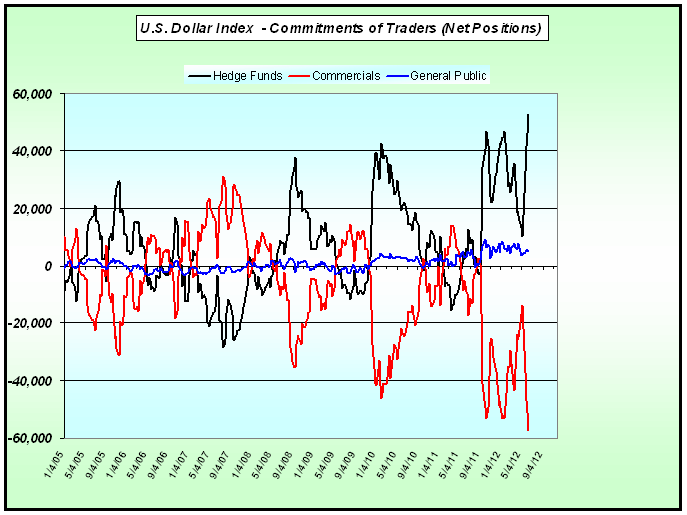
Bullish bets on the US Dollar have reached at least a 7 year high as the crisis in the Euro Zone and the slowing global economy has sent money flows careening wildly into the Greenback.

As you look at the Commitment of Traders chart shown below, you can see that this LONG DOLLAR trade is extremely crowded. Markets in this condition, while they can most certainly continue heading higher, are very unstable and quite susceptible to violent downside action should a technical trigger force a bout of long liquidation.


Friday, we got a bit of a hint as to what might happen to the Dollar should sentiment shift. It was hit rather hard heading into the weekend ahead of the crucial Greece vote as traders began reacting to the possibility of coordinated Central Bank activity early next week. The eager buyers from Monday and Tuesday all ended up as panicky sellers with the market completely erasing its gains early in the week.

Note that the selling did stop at the 38.2% Fibonacci Retracement Level of the rally that began in May.


If, and this is a BIG "IF", the Central Banks do indeed announce a coordinated liquidity infusion, this massive speculative long position may very well be vulnerable.  While certainly the problems afflicting the Euro Zone are not going to be cured by any such Central Bank action, traders will, at least for the short term, view such action as lessening the need for a safe haven. That is when things could get interesting to say the least. I would expect an initial drop down to the 50% retracement level where the mettle of the bulls will be tested.

Longer term, one can still make the case that as soon as further problems begin flaring up over in the Euro Zone, the Dollar will head higher once again but keep in mind, today's markets are dominated by computer algorithms and if those things say "SELL" in regards to the Dollar based on any downside support levels being violated, there is an ENORMOUS amount of longs who are going to get their heads handed to them.

Trader Dan on King World News Markets and Metals Wrap

Please join Eric, Bill and I as we discuss the gold, silver and other pertinent market price action of the past week on the KWN Markets and Metals Wrap by clicking on the following link.


Friday, June 15, 2012

"Heads - I Win; Tails - You Lose"

That's the attitude that gold bulls have apparently adopted heading into this weekend's crucial Greece vote. Whereas yesterday seemed to be a day of caution among traders, today seems to have morphed into a day of expectations of the punch bowl, complete with accompanying hard liquor, being filled to capacity by the Central Banks of the West.

If the Greece vote turns out to be one which threatens the stability of the Euro and sends shock waves through the foreign exchange markets, traders are convinced that a large bouquet of liquidity is coming their way early next week. If the Greece vote turns out to be one in which the party favoring the austerity measures imposed upon the country, then the market will give a collective sigh and the RISK ON trades will be back in vogue - at least until Spain or Italy go kaput.

Either way, we seem to have generated buying in the gold market. Not that I am complaining, being a friend of gold, but I must honestly admit, the entire scenario seems repugnant to me in just stepping back and observing what our economic system, not only nationally, but globally, has degenerated into.

I know the drug addict comparison is old and worn out by now, but it sure as hell seems to me to be the best description of today's financial markets. The problem for the druggie is not that he or she is showing withdrawal symptoms - that is the evidence of an addiction. Their body has grown so accustomed to the presence of this substance that it can no longer functionally normally without it. In other words, the withdrawal symptoms, the shakings, the convulsions, the pain, the distress, are merely the outward evidence of an internal problem - addiction.

So it is in the case of today's financial markets - the symptoms of distress may perhaps be ameliorated by the infusion of additional liquidity - but those are merely the symptoms of an internal problem. That problem is EXCESSIVE DEBT.

For far too long many of the governments of the Euro Zone have lived way beyond their means, spending money with reckless abandon, borrowing more and more, spending more and more, until they have now reached the point at which, just like the addict, more of the drug will eventually kill them. Yet that is EXACTLY what the financial markets want - more of the drug - in essence absolving them of the consequences of their stupidity for spending money they never had in the first place.

Consider the folly of this - the worse the economic news becomes, not only in the Euro Zone, but also here in the US, the better the equity markets perform. Is that not madness? What unbiased observer in the future reading about this insanity will not shake his or her head in astonishment as they marvel that otherwise clear-headed human beings could have been conditioned to behave in such a manner?

Our financial markets are supposed to be a means of allocating precious capital towards segments or industries where goods or services that better our lives can be produced. Instead, they seem to have taken on a life of their own with the roles reversed - in essence the slave has become the master. No attempt can be judged to be incorrect or misquided as long as it serves to resuscitate the price of equities in general. Credit markets must not be allowed to lock up, equity prices must not be allowed to fall sharply, large banks must not be permitted to pay the price for their poor investment decisions - nope - the show must go on, even if in the process we are making fools out of ourselves and deluding ourselves into thinking that Central Banks are the ENGINES of PROSPERITY instead of entrepreneurs and risk takers.

Enough of this display of contempt for now - back to the gold price action - Gold has moved higher on hopes of this aforementioned liquidity coming soon next week. It has pushed through the top of the resistance zone between $1620 - $1630 and is attempting to power past the bullion bank capping efforts at today's high of $1635. Clearing this level will set the market on a path to $1650.

Notice the following 8 hour chart where you can see that it is flirting with the downtrend line formed within the recent congestion zone as well as having moved into the bottom of that zone which was carved out by a top between $1680-$1700 and a bottom near $1625.

If the liquidity punch bowl does indeed come next week in a BIG WAY, look for gold to move initially to $1650 and then, if it can best that level, on to $1680 for a test of that region.

Downside support remains near and just above the $1600 mark.


Tuesday, June 12, 2012

Gold Market Continues to Reflect Currency Turmoil

Simply put - as the situation in Europe further deteriorates (yesterday the market YAWNED at the $125 billion Spain bailout), Italy is now coming into focus. Strangely enough, the US equity markets somehow think all of this is inconsequential as the bulls there continue to be giddy with delight.

Their attitude is best described by an old Steve Wariner song, "Some Fools Never Learn". You play with the fire, you're gonna get burned".

Considering just how tenuous things are, the degree of complacency that exists among equity bulls is nothing short of astonishing. The situation can best be described by looking at a chart of the VIX, or Volatility Index.

While the index has indeed risen from some of its lowest levels down near 14, it is still generating relatively low readings. Apparently traders could care less about potential headwinds; either that or they have already factored in what in their minds is a worse-case scenario. Personally, I think it is symptomatic of the Pavlovian response by this generation of short-sighted economic ignoramuses who believe in the allmighty power of modern Central Bank money creation to plaster over everything that dares arise that might challenge the comfort of the casino players, aka, hedge funds.


I suppose it will work until it just stops working one day and that will be that. Then maybe we will see some economic sanity prevail.


Back to gold however...  The metal was intially weaker early in the session but uncovered a strong surge of buying that some say was linked to the ETF. Regardless of the reason, the fact is that the metal is moving higher and once again looks like it is setting up a challenge of that tough overhead resistance level that comes in near $1620. If it can overcome the bullion bank selling at this level, it should once again make a run towards $1650 and test to see whether it can this time mount a breakout.

Downside support still looks firm.


Saturday, June 9, 2012

Gold Chart and Comments

I have provided an 8 hour gold chart today as it provides a very good glimpse into the technical composition of that market's recent price action.

Note that you can clearly see the solid zone of buying support extending from just slightly above the $1550 level on down towards $1520. It has been at these levels that strong buying has continued to emerge over the last month. I suspect that it is in this zone that Asian Central Banks are gobbling up the metal. Remember, they will not chase the metal higher - only the hedge fund managers buy high and hope to buy even higher before selling. By keeping an eye on this chart we can therefore get a sense of at just what level these buyers believe gold has "value". It is this sort of buying that provides a base for a market upon which it will eventually launch a rally.


For gold, that spark is not there just yet as the absence of an "immediate or forthcoming" QE event means that we lack the ingredient to make the dough rise. However, the continued ultra low interest rate environment, in many instances resulting in negative REAL rates of return, is strongly friendly towards gold as there is little opportunity cost in holding the metal with yields this low. Also, this feeds into the concerns of those who fear continued currency turmoil.

You can also see on this chart that band of congestion or range trade that was bounded by $1700 on the top and checked by $1620 or so on the bottom. Gold had been in that range beginning back in late February/early March with the top of the range retreating down towards $1680 as Europe worsened.

If you notice, this recent rally off the lows near and under $1550 ran right back into this former congestion range before encountering selling pressure from the bullion banks forcing a retreat.

It will take news of a QE launch to take gold up through the top of that former congestion zone and send this market into a strong uptrend.

We are Back - The King World News Markets and Metals Wrap

Trader Dan has been taking a bit of a break away from writing as the volatility in the market tends to wear down even the veterans at times and requires a great deal of undistracted attention to survive.

I am back for the regular weekly radio interview with Eric King at King World News. Join, Eric, Bill (who always provides a terrific insight into what is going on in the world of real gold and real silver transactions) and myself on the Markets and Metals Wrap.


I hope to be able to provide some charting and analyis this coming week. To those who wrote, expressing concern, thanks for that. All is well - just busy, busy, busy, bzzzzzzzzzzzzz.

Oh and by the way, it is SWARMING season for the honeybees up in this neck of the woods. Chasing those down requires time away from the computer screen, which is a welcome relief to be honest! After all, life does exist outside of the markets and accompanying madness!

Saturday, June 2, 2012

Trader Dan on King World News Markets and Metals Wrap

Please click on the following link to listen in to my regular weekly radio interview with Eric King of King World News on the Markets and Metals Wrap program as we discuss this past week's action in the gold and silver markets.

http://tinyurl.com/8yaqlgs

Friday, June 1, 2012

The Futility of QE

This is an attempt to explain what I believe will be the futility of another round of Quantitative Easing on the part of the Federal Reserve to do anything more than to merely provide another TEMPORARY boost to paper assets and by consequence, a short-lived blip in consumer confidence. As such, it is going to be much to the point without any rhetorical flourishes or attempts at refined writing.

I do wish to start this brief piece by noting that I believe the Fed is indeed going to act, sooner rather than later, unless they want to witness a meltdown of the equity markets. Practically, for them to stand idly by and do nothing to prevent it would be irresponsible. Yet for all this, the effort is doomed to failure.

Consider the original purpose behind the Quantitative Easing programs – QE1 was designed to purchase Mortgage Backed Securities which had plummeted in value resulting in a serious degradation of the balance sheets of the major banks and firms that held them as assets.

These “assets” had been originally valued on the balance sheets by marking to model. When the credit crisis began in earnest in the summer of 2008, the world quickly learned that these model-based values were a fiction. The real “market” value of this paper was a fraction of what the banks were claiming.

In order to prevent the credit markets from locking up due to insufficient capital on the part of these large lenders, the Federal Reserve decided to be the buyer of last resort and provide a market for these securities, taking them off the books of the banks and substituting high-quality Treasuries in their place. The idea was to shore up the balance sheets of the banks and give them the ability to lend into the economy for both business and consumer needs.

At the time QE1 was embarked upon, the yield on the Ten Year note had fallen as low as 2.03%.  The investment world reacted to QE1 by bidding up the price of both commodities and stocks and actually sending interest rates higher as the impact from this novel program was expected to be an inflationary one. Yields eventually reached 4% before falling back as the impetus from this first round of QE began to fade.

Fast forward to late 2010 – with the economy still sputtering and growth lagging, the Fed announced another round of Quantitative Easing, this time to the tune of approximately $900 billion. The express intention of this plan was to deliberately push down LONG TERM interest rates and increase the money supply in the hopes that it too would serve to stimulate business and consumer spending and borrowing.

At the time just prior to the commencement of QE2, the yield on the Ten Year had fallen as low as 2.33% as deflation fears were running wild once again. The S&P had lost 16% of its value in the matter of a few months time during the middle of 2010 leaving investors desperately seeking some sort of further action on the part of the Fed.

Oblige they did and once again the equity markets rallied as did the yield on the Ten Year which pushed back towards the ceiling of 4% as once again investors were anticipating an inflationary impact from the policy – which by the way it was deliberately designed to do. However, that was the peak in yields which began falling once again in early 2011 this time dropping below 2.0% before bouncing in a narrow range for a period of 7 months. The catalyst for this downward trend in rates was the knowledge by the entire investment world that the Fed was going to end QE2 in the month of June 2011. In other words, this was all it was going to get – look for nothing else.

Moving to the present time, as the European Sovereign debt crisis has worsened and the contagion effect has spread to China and elsewhere, rates on the Ten Year have now fallen below the critical level of 1.8%, which was acting as a floor. As of today, the yield on the Ten Year has plummeted below 1.5% closing into an all time low at 1.467%.

Here is the point – the purpose behind both QE’s was to improve bank balance sheets thereby facilitating lending, keep longer term interest rates low to stimulate borrowing and ramp up the money supply to produce an inflationary impact to offset the deflationary impact of excessive levels of debt.

One could say that it worked; however, it was only temporary. Operation Twist, which was the last pseudo QE that consisted of rolling the proceeds from maturing short-term Treasuries into longer dated Treasuries, has been an enormous flop as it has provided next to nothing in the form of any inflationary impact.

My question is simple – if interest rates at or near 2% on the Ten Year when the Fed has engaged in both former rounds of QE have been unable to sufficiently increase borrowing/spending for any sustained length of time, what makes anyone actually believe that another round of actual QE, when rates are already well below the 2% level (1.467%) will accomplish the least bit of good?

At some point, you end up with interest rates so low that the money might as well be free to borrow – however, no one wants to borrow or can borrow.

So the Fed can buy another $1 Trillion in Treasuries – how about $2 Trillion – why stop there – why not go to $3 Trillion. What good is all this excess money creation going to do if the previous combination of over $2 Trillion in both QE1 and QE2 has done nothing when all is said and done? Interest rates are already lower than at any point in my lifetime certainly. Has that increased business in the housing market or prevented foreclosures from occurring? Again, maybe for a while it has prevented things from worsening even further but as far as actually laying the groundwork for any lasting improvement, I certainly do not see it.

My guess is that when the Fed does act, and I believe the pressure to act is going to be too great to ignore for long, they are going to have to come up with something besides just Treasury purchases. Maybe they will actually buy stocks or stock indices. After all, if they can push the stock market higher and discourage any potential short sellers from entering, the rising stock market would do wonders for investors 401K’s and other retirement plans. Maybe we will get the same sort of “wealth effect” that we got from the stock market bubble of the late 1990’s. That should boost the Consumer Confidence numbers.

Of course I am being facetious here but if the stock markets begin collapsing as they did back in 2008, can anyone rule out the Fed actually buying stocks as part of a monetary policy response? After all, Japanese monetary authorities have discussed this possibility and been quite forthright about doing so.

On second thought - Why bother – why not just directly inject the money into the bank accounts of taxpayers and skip the usual round of injection through the primary dealers and hoping in vain for a multiplier effect.

One thing is certain – monetary policy alone cannot fix what ails the US economy or the Euro Zone for that matter. The problems are deep-rooted and structural and will require wise action, even painful action, by far-sighted statesmen. Short-sighted political leaders, at this point, are merely leading their nations to irreparable harm and will end up dashing them to pieces on the rocks.

In some sense, the public is partly to blame – they are the ones clamoring for all the government handouts and increased services forgetting that government has no money except that which it confiscates from its citizenry in the form of taxes or from the next generation of taxpayers by deficit spending/borrowing. When its lenders decide that they are no longer willing to lend their capital to nations which follow reckless fiscal policy, the gig is up.

Eventually the Piper must get paid his due.

In closing let me leave you with a graph from the St. Louis Federal Reserve showing why QE has produced no lasting effect....

Note that no matter how the Fed tries to expand the money supply, the Velocity of Money (the rate at which money changes hands in the economy) continues to plummet...

FRED Graph